
Trust, Forecasts, and Action: How Farmers Navigate Monsoon Uncertainty
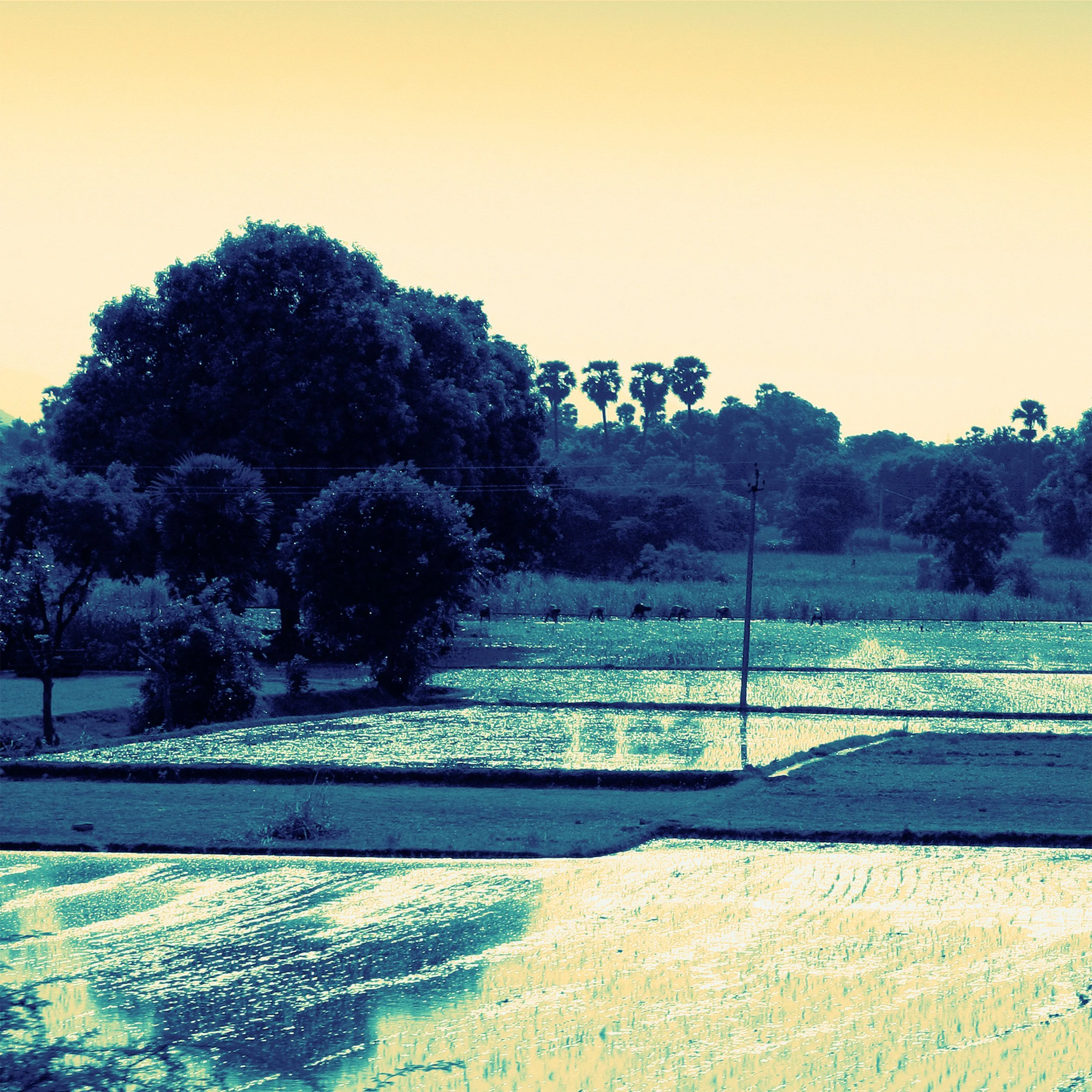
Farmers in Maharashtra and Madhya Pradesh, two major food producing states in central India, perceive the monsoon as more unpredictable than in earlier years. A recent questionnaire-based survey completed by 545 farmers across four districts in central India reveals an interesting relationship between forecast use and adaptive behavior.
When Patterns Become Less Reliable
Farmers who depend on predictable seasonal patterns for decisions about planting, crop selection, and resource allocation face mounting challenges when those patterns shift. The 2025 monsoon illustrated this clearly. In Maharashtra, early rains created opportunities for timely sowing, but the pattern that followed—heavy downpours alternating with prolonged dry spells—disrupted farm management and crop establishment. Rainfall arrived in intense bursts separated by extended dry periods, forcing many farmers to re-sow their crops multiple times.
The experience in Madhya Pradesh's Seoni district differed. Most farmers reported the monsoon beginning on time or slightly late, with more consistent rainfall distribution overall. Yet even with better timing, inconsistent rainfall created conditions favorable for pest and disease outbreaks, which became the primary concern across the district.
The growing uncertainty makes timely weather information potentially more valuable, yet farmers' awareness of, trust in, and use of weather forecasts varies considerably—variation that is strongly related to the cropping systems they manage.
Awareness, Trust, and Use of Weather Forecasts
Farmers were asked about their familiarity with India Meteorological Department's five-day weather forecasts, their confidence in weather forecasts generally, and whether they actively use IMD forecasts in farming decisions.
The responses revealed substantial regional differences. In Maharashtra, most farmers had heard of IMD's five-day forecasts and nearly all expressed confidence in weather information, though actual usage stood at 43%. In Madhya Pradesh, awareness and usage remained much lower, with 38% responding "don't know" when asked about forecast reliability—suggesting limited exposure to weather information services rather than active skepticism.
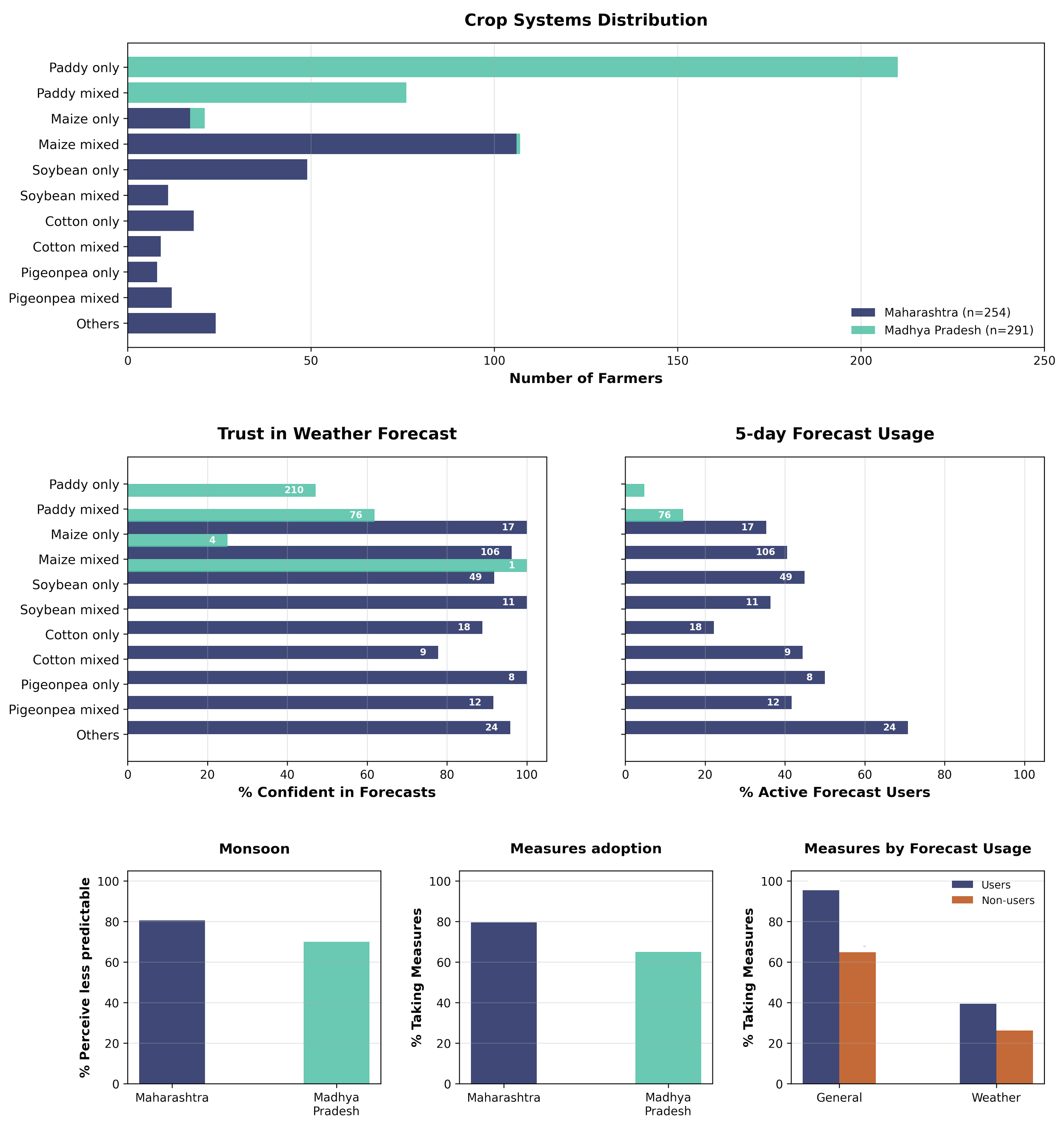
Figure 1 Crop systems (top), trust in forecasts (mid-left), and usage (mid-right) by crop system and perceived monsoon unpredictability change (bottom-left) and adaptive measure adaption per state (bottom-middle). For Maharashtra, users of forecast showed higher measure adoption, both general drought- and flood-related mitigation measures as well as measures related to this year’s weather anomalies - mainly seed selection and crop rotation adjustments (bottom-right). (Madhya Pradesh had too few users to distinguish).
These regional patterns align closely with cropping system differences. Maharashtra's agricultural landscape is more diverse, with farmers managing maize-based mixed systems, soybean, cotton, pigeon pea, and various crop combinations. Madhya Pradesh's farmers, especially in the east, predominantly grow paddy, i.e. rice, most as a monoculture. A significant part of the state lies in the core monsoon zone and receives abundant rainfall. Paddy fields are usually flooded with a shallow layer of water, meaning farmers depend less on daily rainfall fluctuations to maintain sufficient water supply to the plants.
These waterlogged conditions create a more stable, humid microclimate that also affects pest and disease dynamics differently. While paddy faces its share of pressure, disease management becomes more predictable, aligning with crop growth stages rather than day-to-day weather variability. This contrasts with rainfed crops where moisture conditions fluctuate more dramatically, making short-term weather information more valuable for timing interventions.
Among farmers practicing mixed cropping systems, forecast usage reached considerably higher levels than among monoculture farmers. This pattern held even within the same crop: paddy farmers who also grew maize, wheat, or pulses showed three times higher forecast usage than those growing only paddy.
Managing multiple crops with different timing requirements, water needs, and climate sensitivities corresponds with higher perceived value of weather information. Short-term forecasts become more valuable when farmers must coordinate decisions across crops with different requirements and vulnerabilities, compared to managing a single crop with relatively standardized practices.
Forecasts and Protective Measures
Farmers who actively use weather forecasts are also those taking measures to protect their crops and livelihoods. In Maharashtra, where forecast adoption is more established, 95% of forecast users reported taking measures against heavy rainfall, compared to 65% of non-users. The pattern held for drought measures as well, though both groups showed high rates of drought preparedness.
Crop insurance adoption followed a similar pattern, with substantially higher rates among farmers in regions with greater forecast engagement.
The relationship becomes more direct when examining adjustments made in response to recent weather conditions. When asked whether weather changes had prompted them to consider adjustments in crop varieties, seed selection, or farming practices, 40% of forecast users in Maharashtra answered yes, compared to 26% of non-users. Farmers mentioned condition-based seed selection and crop rotation decisions as common responses.
These general protective measures like insurance differ from specific adjustments to recent weather—the latter showing a more immediate connection between observed conditions, information use, and farming decisions. Farmers using forecasts appear more likely to both maintain ongoing risk management strategies and adjust practices based on changing conditions.
Information Needs Across Timescales
Weather information serves different decision-making needs across different timescales. Five-day forecasts help farmers time immediate operations: when to spray, when to irrigate, when to harvest. These short-term decisions matter enormously for protecting investments and optimizing yields, particularly for farmers managing complex cropping systems with multiple crops that have different sensitivities to temperature, soil moisture, and pest risks at different growth stages.
But farmers also make decisions that require longer time horizons. Which crops to plant? How much area to allocate? When to expect market pressure from production elsewhere? These questions require understanding not just next week's weather, but how the current season compares to normal patterns, what's happening in other growing regions, and how weather events are affecting production and trade flows.
The relationship between forecast engagement and adaptive behavior observed here suggests that when farmers have access to timely, relevant information, they use it to manage risk more effectively. As weather variability continues to increase, building information infrastructure across multiple timescales becomes increasingly important.
What Uncharted Waters Does
Uncharted Waters monitors weather volatility and its impacts in real-time, tracking how climate events affect crop production and how water resources buffer these impacts, while analyzing how disruptions cascade through global food supply chains. Our digital twin of the global food system integrates process-based crop modeling with machine learning to provide monthly updates on weather events, water availability, recent harvests, and expected production.
In India, we partner with WOTR to integrate climate and crop intelligence into advisory services. One such service is WOTR’s five-day weather forecasts, created in cooperation with the Indian Meteorological Department, to support immediate operational decisions. By monitoring supply, demand, stocks and trade flows in real-time, we deliver additional market insights before official statistics become available—helping organizations from local NGOs supporting farmers to businesses managing agricultural commodity risk make informed decisions faster.
This project in Maharashtra and Madhya Pradesh, supported by the Kyeema Foundation and Palladium, represents our commitment to evidence-based approaches that triangulate multiple sources of knowledge. The questionnaires provided insight into how forecast engagement relates to adaptive behavior, revealing patterns across different cropping systems and regions. We're validating our model projections against actual harvest outcomes, learning how climate information translates into on-the-ground realities, and refining how different types of knowledge work together to strengthen decision-making.
As weather variability continues to increase, timely insight on current production, expected supply, and farmer conditions becomes crucial for anticipating risks and managing uncertainty effectively. Understanding who uses forecasts and how that relates to protective actions provides guidance for building more resilient food systems through integrated, evidence-based approaches.
Uncharted Waters works with Wageningen Environmental Research and WOTR to assess climate impacts on water and food systems. This analysis was conducted in partnership with WOTR's farmer network in Maharashtra and Madhya Pradesh, with support from Kyeema Foundation and Palladium.